While so many
bloggers have suggested the usable tools to their audience, how could i lag? Although
Scott Hanselman have covered most, and it's a mountain high to climb, let me introduce my favourite top 10 developer-must-have apps:
1)
Notepad++ (Language: neutral)
when you need it?
a) View Unix files in Windows platform, especially during Java development.

when you open a come-with-JDK Java file using notepad
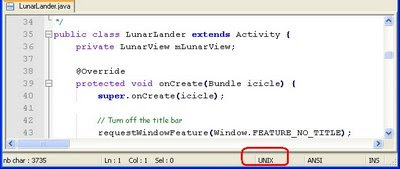
when you open it using Notepad++, it's well-formatted
b) Need to probe the
_ViewState of ASP .NET
web page to see how
stateless HTTP retains value after post-back, using
base64 decode. (you can try it
here)

A normal ASP .NET with its HTML source

Copy the content to Notepad++

Decode it to base64, you can see your state retained
c) Determine Byte-Order-Mark of a file, whether it's saved in following formats: UTF-8, UTF-16, UTF-16 (LE), UTF-32 (BE), UTF-32 (LE), UTF-7, UTF-1, UTF-EBCDIC, SCSU, BOCU-1. And it's exactly .Net method GetPreamble trying to do.
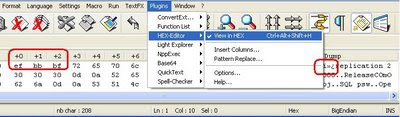
Did you see extra three bytes ahead your file content?
d) it's lightweight, unlike Visual Studio IDE, although Noah Coad might beg to differ.
e) Hey! "All I've mentioned above, other editors have the same features as well". Well, simply I like its UI also.
2)
Unlocker (Language: neutral)
when you need it?
a) When you want to delete a file which is being viewed/locked by hidden host. That's nothing more annoyed than this.
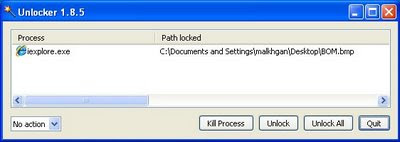
b) When a file get locked by your app, especially using class
File.IO to write it without closing the stream properly.
c) When you try to delete an old ASP .NET version 1.1 web projects in "
Inetpub" that's being locked by
IIS.
3)
Dependency Walker (Language: native)
when you need it?
a) When you need to determine a
EXE is a native
exe or .NET managed
exe. Why, because you can
decompile the source accordingly later :)
 A .NET exe
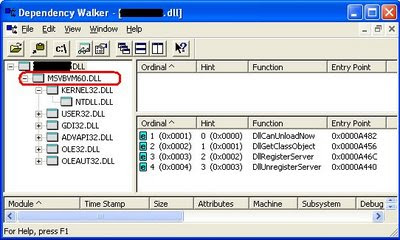
A VB6 dll
b) Of course, find the exe/dll dependencies, as the name implies. When you were in the pre-NET era with only Visual C++/Visual Basic 6 & Package Deployment Wizard, there's no such thing called MSI technology, which can help you to determine most of the dependencies for you.

4) Process Explorer (Language: neutral)
when you need it?
a) When you need to find out what process/apps/service is running secretly. You'll never know your employer have planted a window service for software inventory control on your laptop, until you run it.
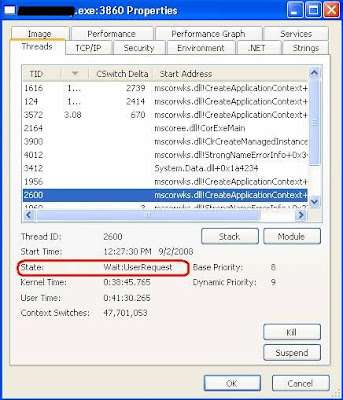
 b) Check the thread state of a stopped thread, probably due to Timeout of Three-Way Handshake in FTP uploading/downloading, when you suppose to have a multi-threaded app run without stopping FTP upload/download.
5) Microsoft Network Monitor (Language: neutral)
when you need it?
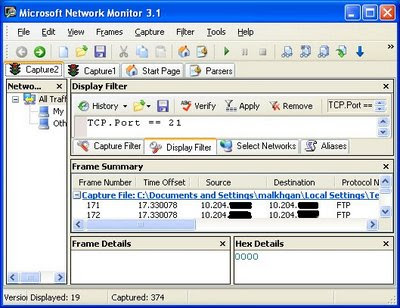
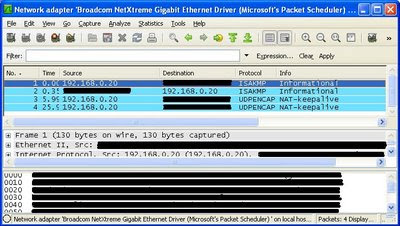
a) When you have written a FTP client app running well on uploading files, but FTP server complaint it never receive. You can show this to prove.
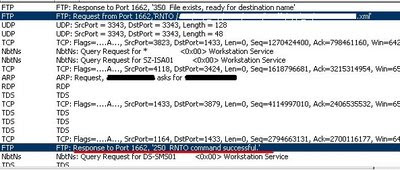
b) When you need to sniff network traffic, especially on FTP since all the commands are transferred
thru'
Cleartext.
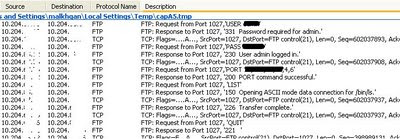
Wow, you can see user-name and password!
6) Reflector (Language: .NET)
when you need it?
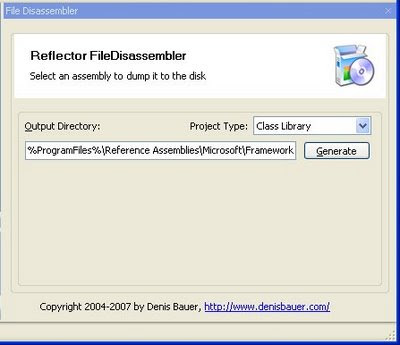
a) When you need to re-generate the source that lost and you do not have any source control previously, with the aid from plug-in, FileDisassembler
b) When you need to find the difference between the
exe/
dll you deployed, with the another aid from plug-in,
Diff
7) DebugView (Language: native/.NET)
when you need it?
a) When your app only with issue happens intermittently, you need your app to run in verbose mode using Debug.Print without additional tracer running side-by-side, that might affect the performance, or introduce new bug/maintenance issue. This works well for native app too, using Win32.
 8) 7Z (Language: neutral)
when you need it?
a) It supports most of the commercial format, yet without asking you to purchase every time it loads, eg. WinZip, Winrar. Furthermore, it able to compress more to save your disk-space.
 b) When you need to find out how the zip file is created. Either SharpZipLib or Windows built-in zipping tool; compression method is either DEFLATE, Implode, or Store. You can get the Host OS and CRC as well.
 this zip file is compressed using SharpZipLib with DEFLATE method
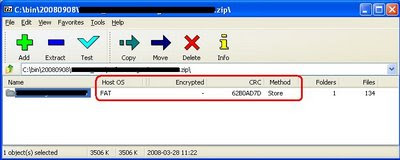 this zip file is compressed using Store method
 this zip file is compressed using Windows built-in zipping tool
9) Microsoft Virtual PC (Language: neutral)
when you need it?
a) When you wish to be beta tester yet you do not want to jeopardize your existing system.
b) When you found virus, and you need to cultivate it in order to trace the originator, so that... counter-hack!
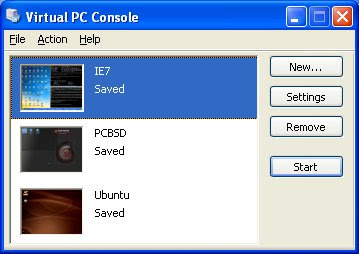
c) When you need to test your web app in different OS. MS has prepared it for you to use it until January, 2009. Flavours available: Windows XP SP3 with IE6 VHD file, Windows XP SP2 with IE7 VHD file, Windows XP SP3 with IE8 Beta 2 VHD file, and Vista Image with IE7 VHD file. (see: Internet Explorer Application Compatibility VPC Image)
d) When you wish to play around with different *-nix OS.
10)
Windiff (Language: neutral)
a) Basically for file compare and directory compare. I have used it since development in Visual C++ 6.0. Though it might not user-friendly,
eg, cannot compare in separate panes, cannot compare Unicode/
UTF-8 files. But it comes with Visual C++ 6.0 and have been with me so long, I feel hard to say goodbye to it.


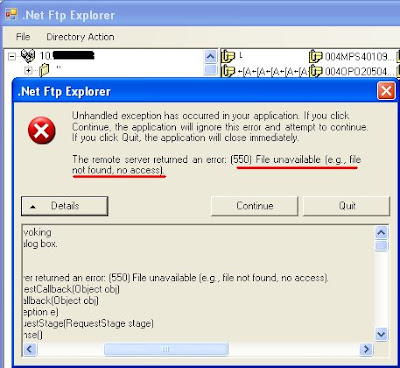


 By modifying the attribute, the delete command is able to delete the file again. I think the application on client side does not have the ability to check the file's attribute, at least for Windows FTP service (